Backpack Defender

A design proposal for a fun motion-activated alarm that guards a kid's backpack or locker.

76 × 51 × 26 mm, deck-of-cards size 2 × AAA, pull one to disarm 5 alarm voices ≈ $5.40 electronics
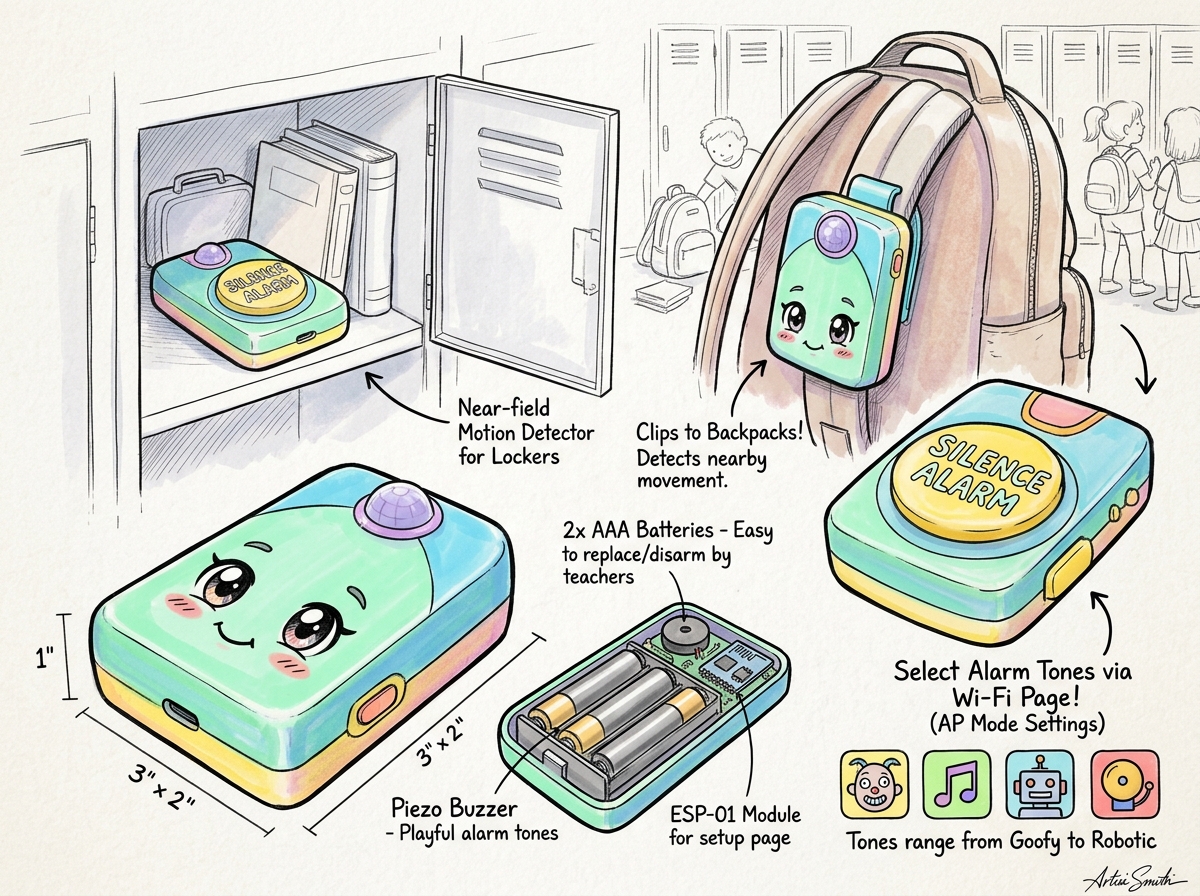
Watercolour concept sheet: a mint, butter-yellow and lavender pebble-shaped gadget with a kawaii face, a purple sensor dome and a big yellow 'Silence Alarm' button, shown in a locker and clipped to a backpack.
Hands off my snacks! ♡
Who it's for

For kids whose stuff keeps "wandering off"

School-age kids, roughly 6 to 12. It's a toy, not a security system: a cute guard with a loud, silly voice that makes a sneaky hand think twice, and makes the owner grin.

8:12 am · Locker 214

Lies flat on the shelf

It sits on its big flat side, face up. When the door swings open and a warm arm reaches in, the purple dome sees it and the alarm goes off. If it's the owner, one slap of the big button shuts it up.
12:30 pm · Lunch line

Clipped to a backpack

A charm loop on one end takes a keyring, a carabiner or a zip tie. The face looks out, and anyone unzipping the front pocket gets a robot shouting "INTRUDER" at them.

1:05 pm · Mid-lesson

Teachers can stop it in one move

The silence button is huge on purpose, so anyone can see how to stop it. For a full disarm, pop the battery door and take out a AAA. No app, no tools, no password.

Spin it around

The real enclosure

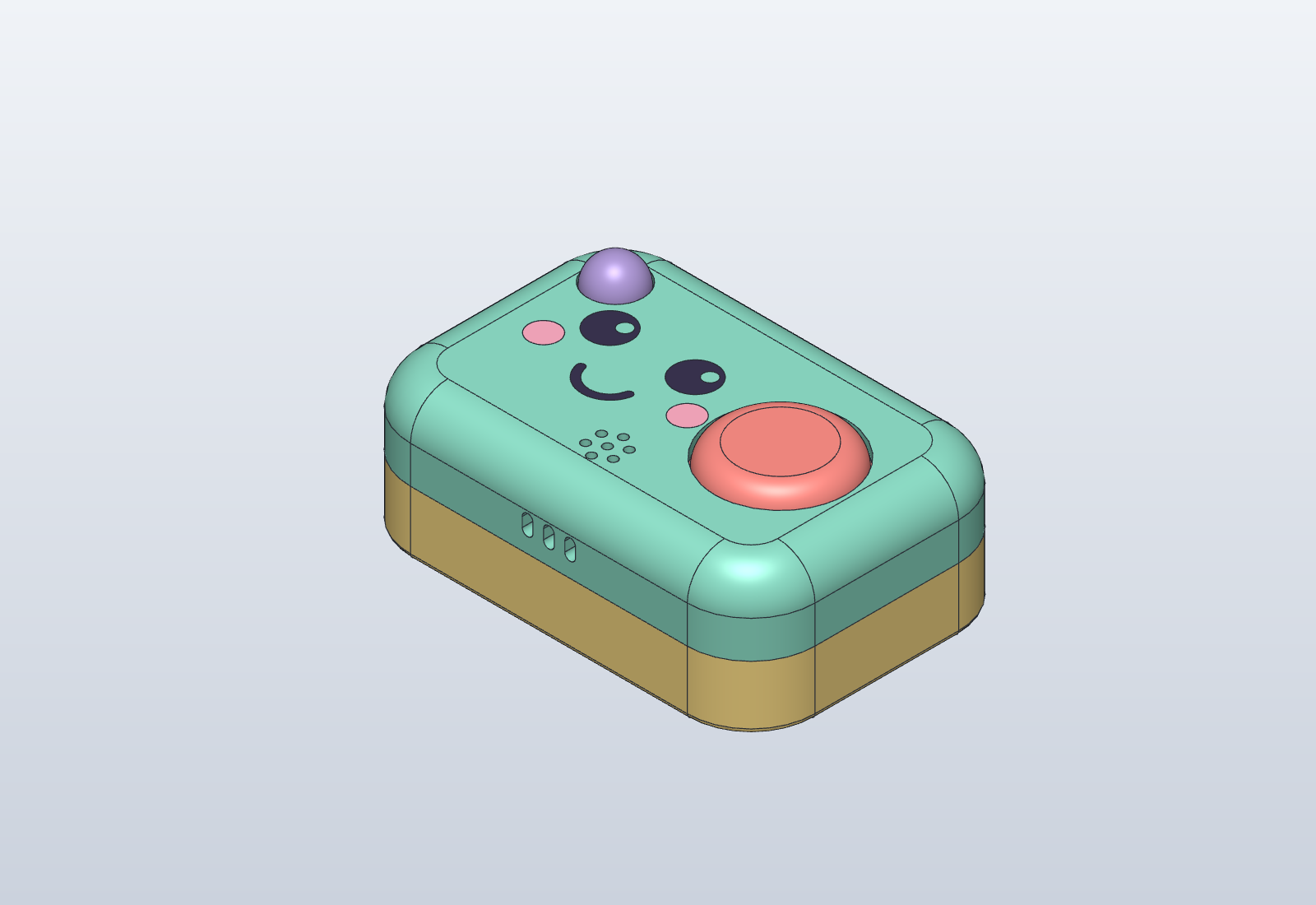
This is the Stage 4 CAD model, not a render of the art. It's a soft pebble in mint, butter and lavender, sized around real, cheap parts. Drag to rotate, pinch or scroll to zoom.

  • 1Silence buttonA Ø24 mm coral dome, held captive by a flange, that presses a 12 mm tact switch. It's also the setup key.
  • 2Motion "eye"The AM312 PIR's lavender Fresnel dome pokes 4 mm through the lid and looks straight up.
  • 3Sound holesSeven Ø1.6 mm holes sit right over the piezo's port, with a three-slot grille on the front edge.
  • 4Charm loopA tab with a Ø4 mm hole for a keyring, carabiner or zip tie.
76 × 51 × 26 mm2.0 mm wall11 parts

The face is flush inlays (plum eyes, pink cheeks) and could become a pad print or a sticker in production.

Pick its voice

Five alarm voices, picked from a phone

Hold the big button while you put the batteries in. Backpack Defender starts its own little Wi-Fi network with a settings page, so there's no app and no account. Pick a voice, hear a preview, save it.

Try it: play a voice on the phone, then hit the button. These previews come from your browser's synthesiser. On the real thing they play through a 12 mm piezo, which sounds buzzier.

📶 BackpackDefender-7F3A192.168.4.1

Hi! Pick my voice

Tap to preview · battery 87%

Mock-up of the setup page the device serves. Nothing here leaves your browser.

How it behaves

Asleep almost all the time, loud when it counts

The firmware plan from Stage 5. Deep sleep is what lets two AAA cells last most of a school year.

ARMED

Snoozing

The ESP32-C3 sleeps at about 5 µA. The PIR or the button can wake it, and Wi-Fi stays off.

ALARM

Squeals

Motion wakes it. It turns the amp on, streams the chosen voice for about 10 s, then goes back to sleep.

SILENCE

Shh

One press stops the sound and ignores motion for a cool-down (about 60 s) so the owner can get their stuff.

SETUP

Hello, phone

Hold the button at power-on to start the hotspot and settings page. The choice is saved to flash.

What's inside

One small board, two AAA cells

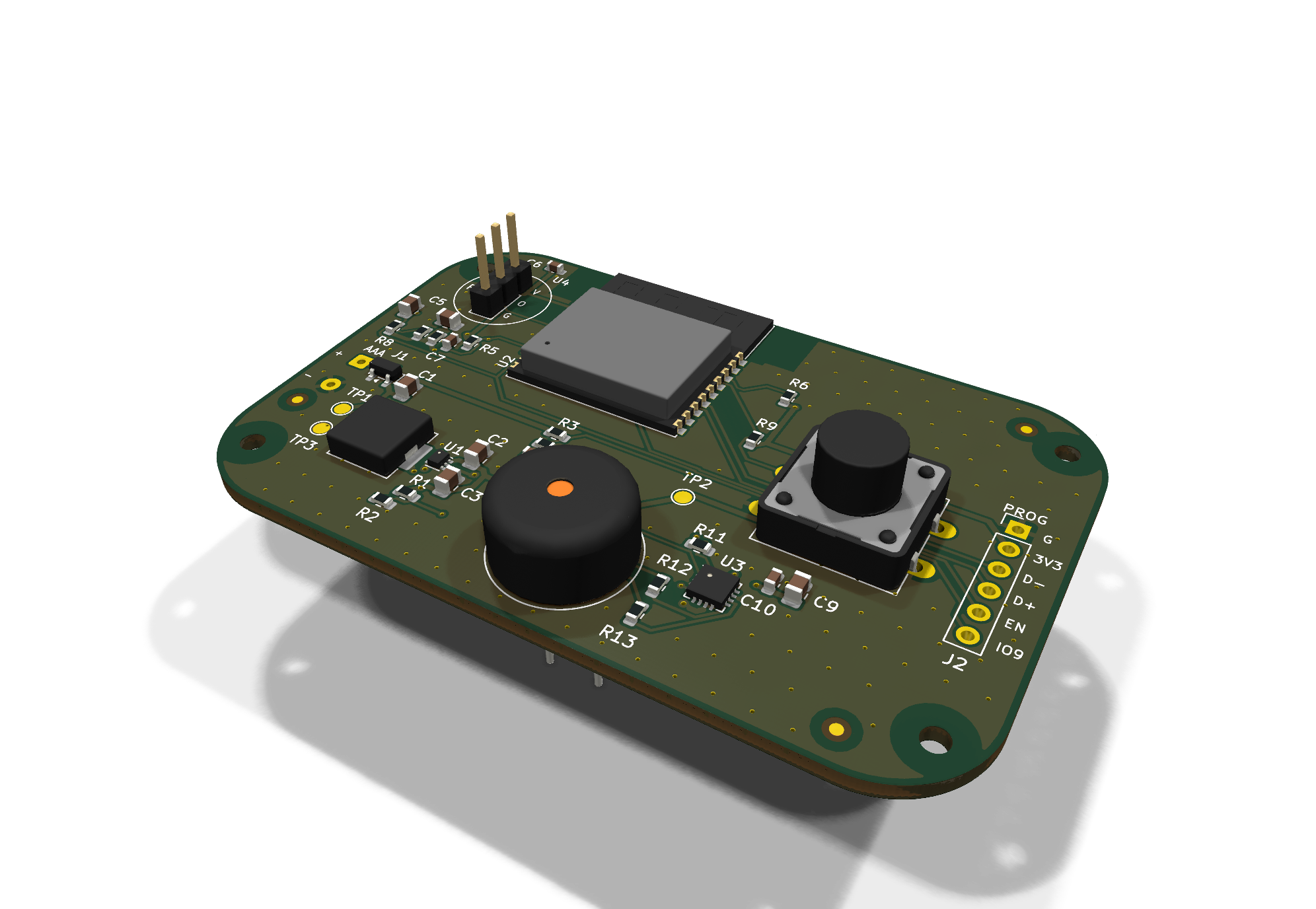
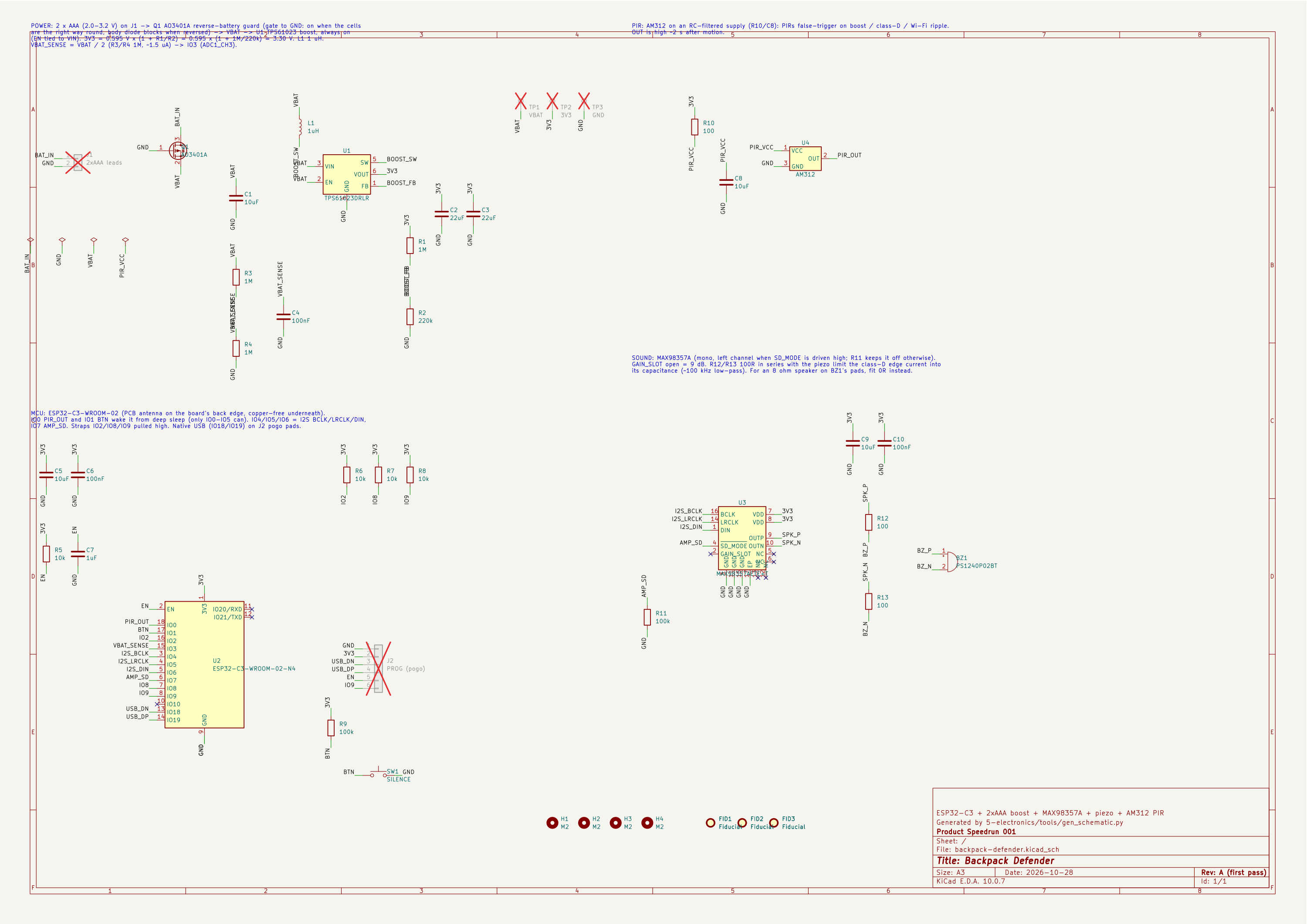
A 70 × 45 mm two-layer board sits on four posts above the batteries. All 43 parts are on top, because the battery holder is just 0.5 mm below the board. It's fully routed, with zero ERC errors and zero DRC violations in KiCad 10.

~90 µA
from the cells while armed, about 12–15 months of pure standby
6–9 mo
per set of AAAs, at ~20 alarms a day plus a weekly setup
≈ $5.40
electronics at 1k units, before assembly
43
components, 111 pins, all checked against their intended nets

The board in 3D

Stage 5 · KiCad export

How it stacks up

  • PIR dome and bottom plate~30 mm
  • Silence button top28.5
  • Mint lid12–26
  • Piezo, switch, moduleto ~23
  • PCB, 1.6 mm14.5
  • 2 × AAA, side by side2–14
  • Butter base0–12

Schematic side view, not to exact scale for every part. Heights in mm above the floor.

Brain + Wi-Fi

ESP32-C3-WROOM-02

U2 · 18 × 20 × 3.2 mm

Hosts the hotspot settings page, plays tones over I2S, and wakes from deep sleep on a GPIO with no extra parts. It has native USB, so there's no serial chip.

~$1.90
Voice

MAX98357A + PS1240 piezo

U3 · BZ1

A filterless class-D amp takes the digital audio and drives a Ø12 mm TDK piezo, loudest near 4 kHz. Two 100 Ω resistors tame the edges.

~$1.45
Eye

AM312 mini PIR

U4 · Ø10 Fresnel lens

Near-field (3–5 m) with a digital output, drawing about 15 µA. An RC filter stops boost and Wi-Fi ripple from setting it off. Radar was rejected because it sees through locker walls.

~$0.80
Heart

TPS61023 boost

U1 · L1 1 µH

Two AAAs sag from 3.2 V to 2.0 V. The boost holds a steady 3.3 V and copes with 650 mA Wi-Fi peaks.

~$0.45
Kid-proofing

AO3401A guard FET

Q1 · SOT-23

Kids will put batteries in backwards. This one-cent P-FET shrugs it off and costs only ~40 mV of drop.

~$0.01
Big button

12 × 12 × 7.3 tact switch

SW1 · THT

Sits under the coral cap. A 0.4 mm pocket in the cap keeps it from pressing the switch all the time.

~$0.08
Full bill of materials (18 lines)
RefQtyValueDescriptionMPN
U21ESP32-C3-WROOM-02-N4ESP32-C3 Wi-Fi/BLE module, 4 MB flash, PCB antennaESP32-C3-WROOM-02-N4
U31MAX98357AI2S class-D mono amplifier, TQFN-16 3 × 3 mmMAX98357AETE+T
U11TPS61023Synchronous boost converter, 0.5–5.5 V in, 3.7 A switch, SOT-563TPS61023DRLR
U41AM312Mini PIR motion sensor, Fresnel dome through the lidAM312
BZ11PS1240P02BTPiezo transducer, 12.2 mm, ~4 kHz resonancePS1240P02BT
SW11SILENCETactile switch 12 × 12 × 7.3 mm THT, under the big buttonTS-1212-7.3
Q11AO3401AP-MOSFET −30 V −4 A SOT-23, reverse-battery guardAO3401A
L111 µHPower inductor, 9 A sat, 7 × 6.6 mmFXL0624-1R0-M
C1 C5 C8 C9410 µFCeramic, 25 V X5R 0805CL21A106KAYNNNE
C2 C3222 µFCeramic, 25 V X5R 0805CL21A226MAQNNNE
C4 C6 C103100 nFCeramic, 50 V X7R 0603CC0603KRX7R9BB104
C711 µFCeramic, 50 V X5R 0603CL10A105KB8NNNC
R1 R3 R431 MResistor 1 % 06030603WAF1004T5E
R21220 kResistor 1 % 06030603WAF2203T5E
R5–R8410 kResistor 1 % 06030603WAF1002T5E
R9 R112100 kResistor 1 % 06030603WAF1003T5E
R10 R12 R133100 ΩResistor 1 % 06030603WAF1000T5E
BT112 × AAA holderSide-by-side, wire leads (~52 × 25 × 12 mm), soldered to J1generic
From doodle to board

How we got here in one episode

Concept art sheet
STAGE 2

Concept art

The vibe: a pastel pebble, a kawaii face, a playfully huge button.

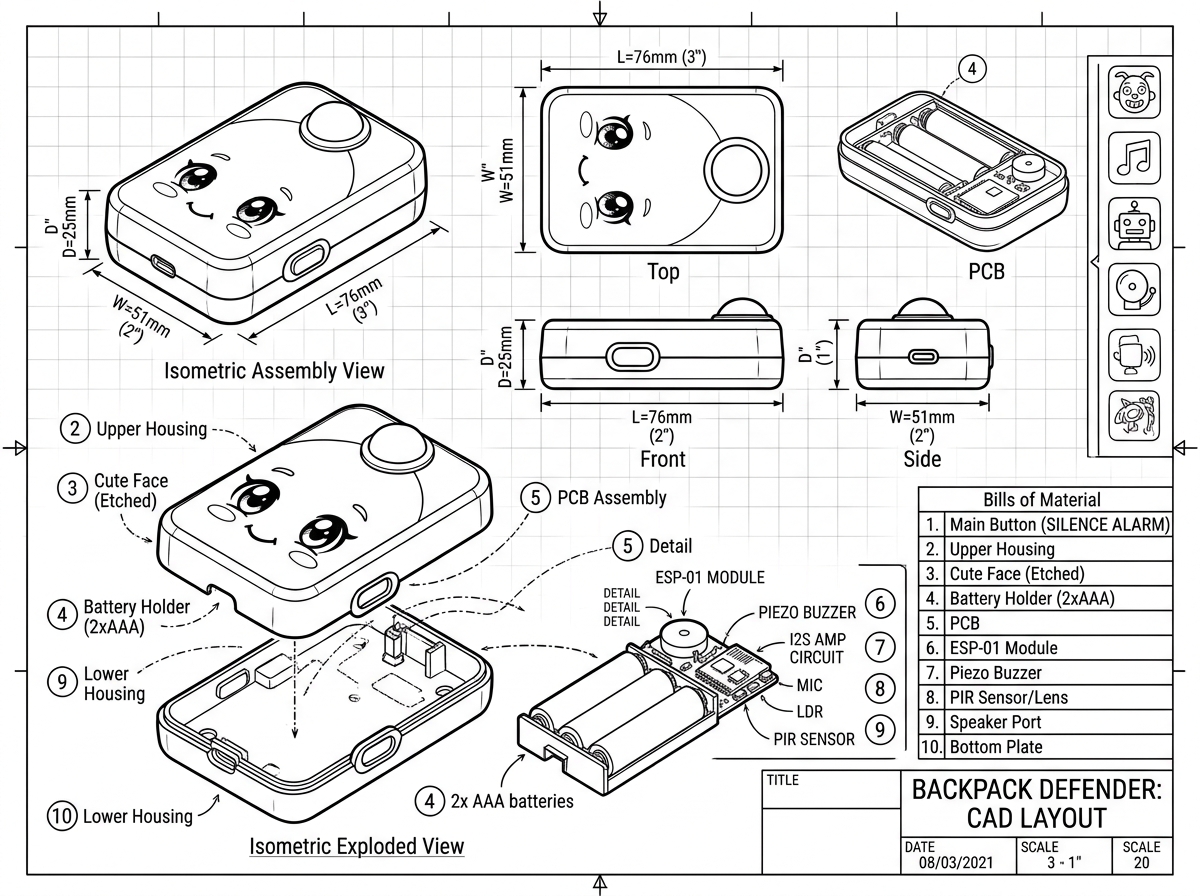
CAD-style isometric layout sheet with views and parts list
STAGE 3

Layout sheet

Views, a 76 × 51 × 25 mm envelope, batteries under a board.

Isometric screenshot of the CAD enclosure
STAGE 4

Enclosure

Parametric CAD, 11 parts, clearance-checked with no overlaps.

3D render of the circuit board
STAGE 5

Electronics

KiCad schematic and routed board, fitted back into the shell.

What's next

What we still don't know

This is a first pass from a speedrun. It's credible and buildable, but nothing has been printed, ordered or heard by an actual kid yet. Here's the honest list.

Build on it

Everything behind Backpack Defender is open: the 3D design, the KiCad boards and the notes. Download it, change it, make it, even sell it. All we ask is a credit and a link back.

Open the project on GitHubLater revisionsThe build tools

Continue it with an AI agent

Paste this into Claude Code, Codex, Cursor or any agent that can run commands. It fetches just this project and the tools, reads the notes in the right order, and asks you before it changes anything.

Hardware under CERN-OHL-P v2, words and images under CC BY 4.0, code under MIT.

Get each run by email

A short diary of every episode: the roll, the turns the idea took, and the board at the end. One email per episode.