• ActHaptic motor
  • UserNew parent
  • Form factorWearable
  • VibeY2K

Baby Monitor Monitor

A design proposal for a baby monitor accessory. You feel the crying instead of hearing it, so you can sleep with earplugs in.

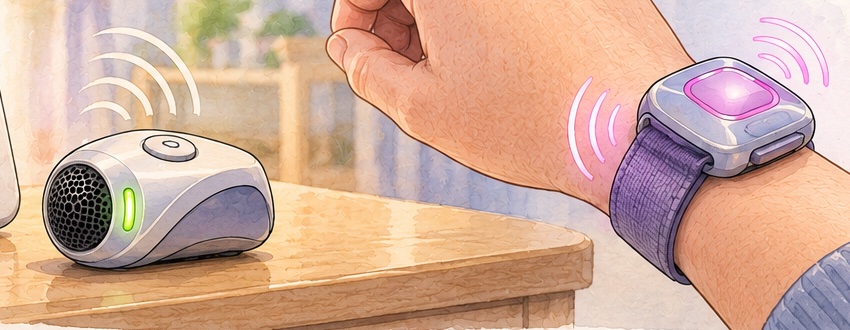
A pearl-white mic sits next to the monitor and listens to its speaker. When the baby fusses, the watch on your wrist or ankle buzzes: gently for a whimper, harder for a full cry. It keeps going until you tap "I'm awake".

63 × 43 × 33 mm
The sensor: too big to swallow
38 × 38 × 12.7 mm
The watch, on any 20 mm band
ESP-NOW
Direct link: no app, no router, no cloud
Sealed watch
No button, no port: it charges on a magnetic clip
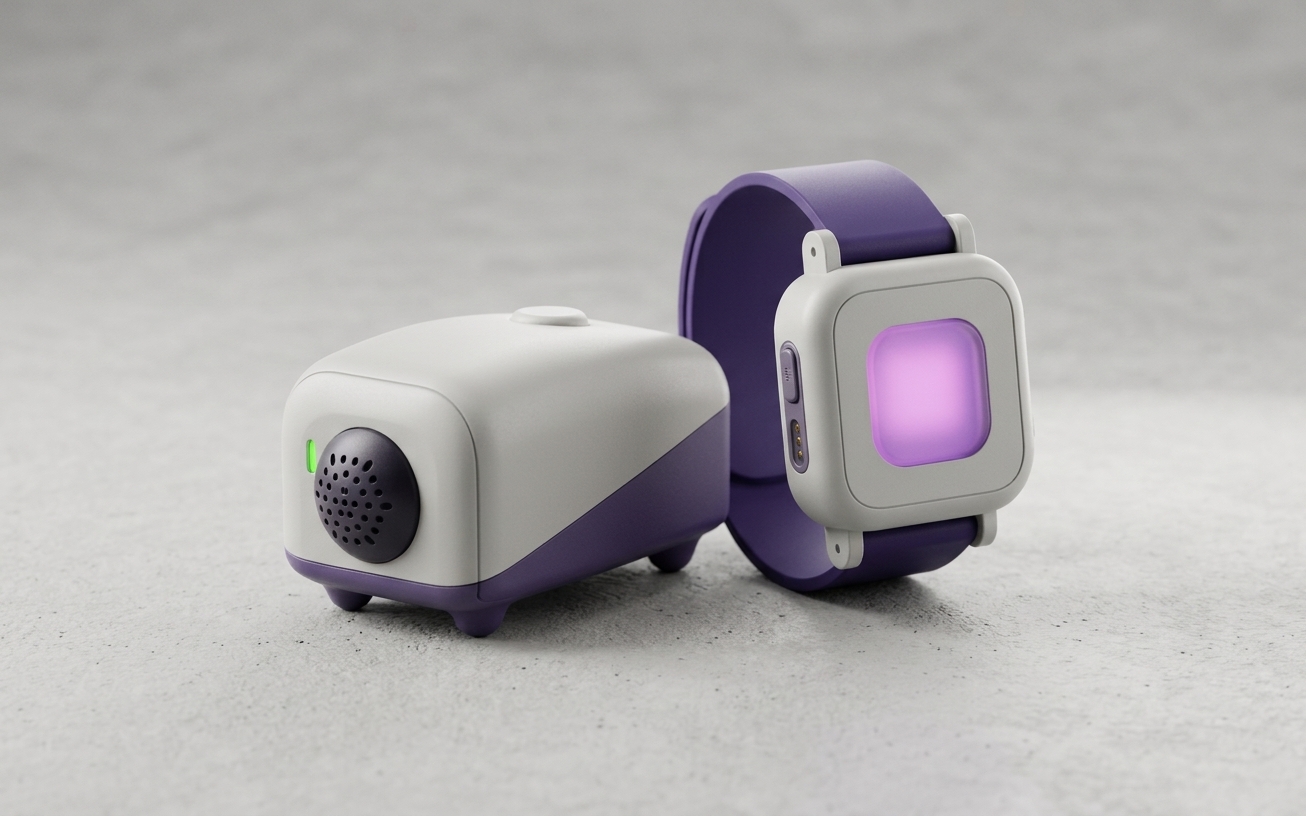
Render: a pearl-white sensor with a dark round mic grille, a green status light and a purple lower half, next to a square white watch on a purple band with a glowing magenta lens
An AI render of our Stage 4 CAD model. The final watch is sealed: the side controls in this render are gone.

Two parents, one bed, one on duty

The one on duty wears it. The one off duty gets to sleep.

The parent on night duty

Earplugs in, and still listening

The monitor's hiss, a snoring partner or the street outside keeps them awake, but earplugs feel like neglect. With the watch on, they can block out the room and still be the first to know when the baby actually needs them, and how urgently.

The parent who's off tonight

Sleeps through the whole thing

A beeping monitor wakes everyone in the room. A buzz on one wrist wakes one person. Swap the watch at the next feed, or strap it to an ankle if wrists are busy holding a baby.

Concept art: the pearl-white mic sensor on a bedside table, its green light on, while the purple watch buzzes on a raised wrist
"Bzz. Bzz-bzz. BZZZ."3:12 am. The monitor is at normal volume across the room, the earplugs are in, and the wrist feels the crying ramp up before anyone else in the house hears it.

Turn up the intensity

Pick what the monitor is playing. Every 250 ms the sensor measures how loud it is and sorts that into one of four levels. The watch buzzes to match, a little harder with each round, until someone taps "I'm awake".

BMM · sensor link
LVL 0QUIET
loudness 18

All quietThe green link light blinks with the sensor's heartbeat.

This is a simulation of the first-pass firmware plan, not real audio. The thresholds are guesses, and a real sensor would be calibrated to your monitor's volume. The phone buzz only works in browsers that support vibration (most Android phones, not iPhones).

43D model in Solidcraft

Pearl shells, chrome grille, one glowing lens

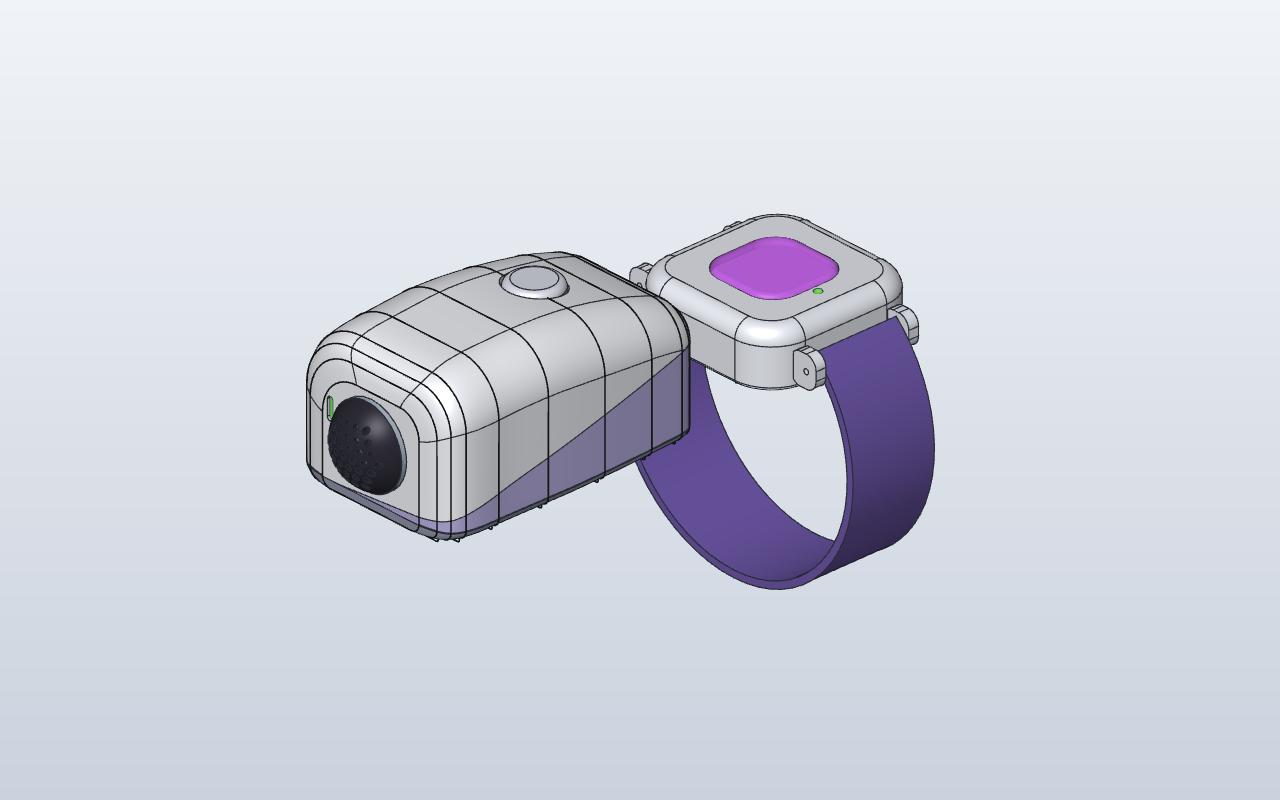
Both devices are in one first-pass CAD model, sized around real parts: the cells, the coin motor and the two routed boards. Drag to spin it.

  1. Sensor shellA lofted, asymmetric "gamer mouse" body, 63 × 43 × 33 mm, with a lavender swoosh sweeping up the sides. Too big for the small-parts test cylinder in any orientation.
  2. Stage-mic grilleA chrome collar and a domed honeycomb cage on the nose, with a green status slit beside it. The mic sits right behind the cage.
  3. Controls and mountingA Ø12 "I'm awake" button on the crown (tap to stop the buzz, hold to pair). USB-C and a lavender power slider are on the back, with a VHB pad underneath for sticking it to the monitor.
  4. The sealed watch38 × 38 mm with no holes in the sides. The magenta lens is a diffuser over an RGB LED, not a screen. A green link light sits at 6 o'clock.
  5. Skin-side back plateThe coin motor is glued inside so the buzz goes straight into the skin. Two gold charge contacts and two off-centre magnets mean the clip charger only fits one way. The 20 mm spring bars take any elastic band.
5Electronics in KiCad

Two boards, one link

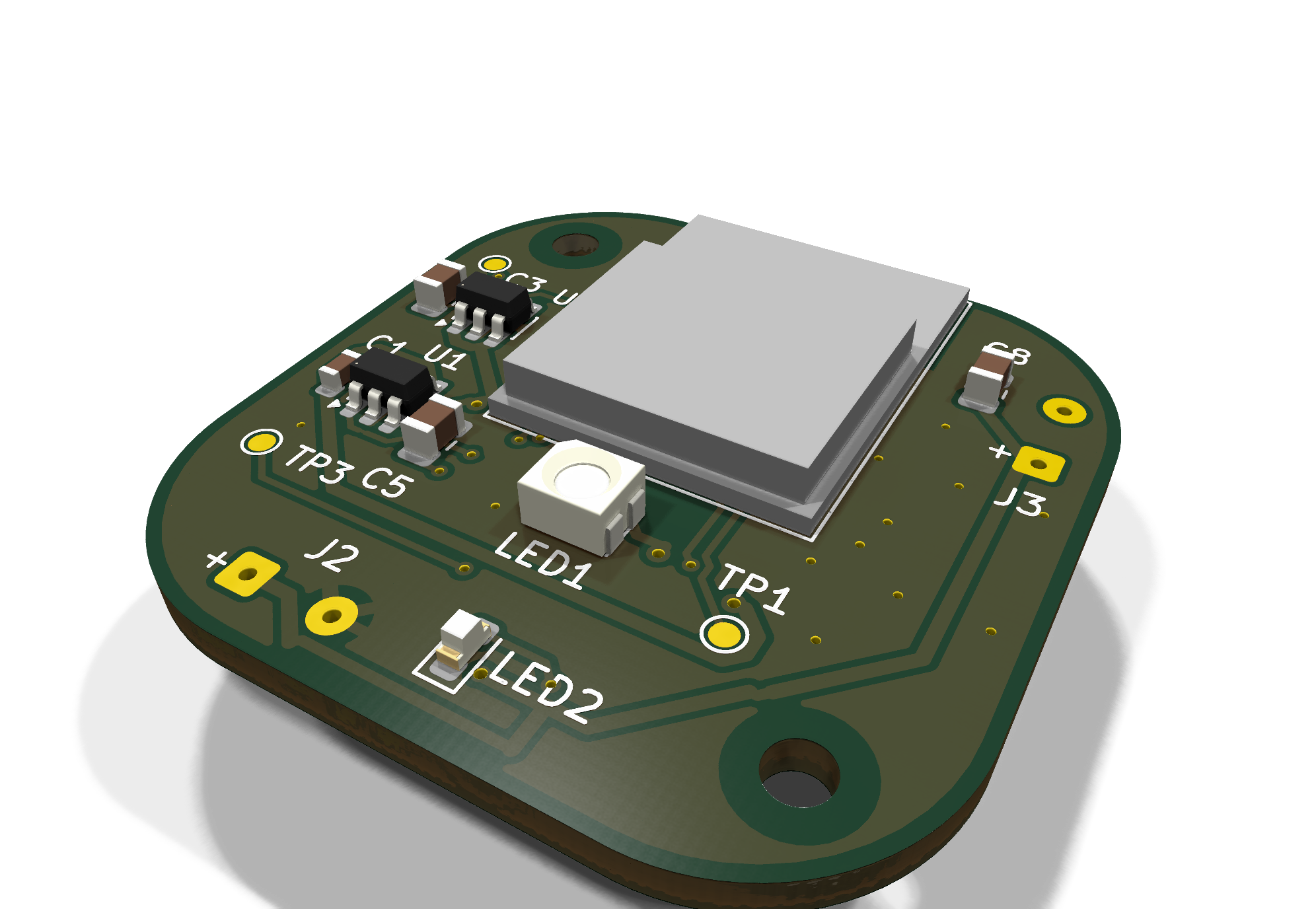
Each device has its own routed two-layer board with an ESP32-C6 module, and the two talk directly over ESP-NOW. The sensor's 52 × 24 mm board hangs in its crown, and the watch's 30 × 30 mm board hangs under the lens. Both carry parts on both faces.

0 / 0DRC violations and unrouted connections, on both boards
57Components across the two devices
~3 nightsThe sensor unplugged on its 2000 mAh cell (estimate)
~1 nightThe watch on 150 mAh, charged daily (estimate)

Sensor board52 × 24 mm

Routed in KiCad with Freerouting

Watch board30 × 30 mm

Routed in KiCad with Freerouting
U3 × 2 · ESP32-C6-MINI-1-N4

Two brains, no router

ESP-NOW links two ESP32s directly in about a millisecond, with no Wi-Fi network, no app and no account. The sensor sends a heartbeat every few seconds, and if it stops, the watch gives a "lost link" buzz.

U4 · ICS-43434

Ears

A digital I2S MEMS mic, ported through the board to the grille. The sensor measures loudness every 250 ms and sorts it into quiet, fussing, crying or screaming.

M1 + Q1 · coin ERM + AO3400A

The buzz

A Ø10 × 2.7 mm coin motor, switched by a MOSFET at 20 kHz with a flyback diode. Intensity is set by the PWM duty, capped at about 70 % because the motor is rated for 3 V.

LED1 · WS2812B-2020

The Winamp glow

A 2 mm RGB LED under the frosted lens. Its colour follows the level, and it blinks green when the "I'm awake" tap arrives.

P1–P2 · pogo pins + MCP73831

Charging without a port

Two spring pins press on gold contacts in the back plate. A Schottky diode blocks reversed polarity and keeps the cell's voltage off the exposed contacts, so sweat can't drain it.

J1 · USB-C, SW2 · PCM12, BT1 · 103450

Sensor power

USB-C runs the sensor beside the monitor and charges a 2000 mAh cell for nights away from home. A power-path switch stops it float-charging all night, and a slide switch turns it fully off.

Sensor bill of materials (21 lines)
Loading the parts list…
Watch bill of materials (19 lines)
Loading the parts list…

How we got here

From a roll of "haptic motor, new parent, wearable, Y2K" to two routed boards in one episode.

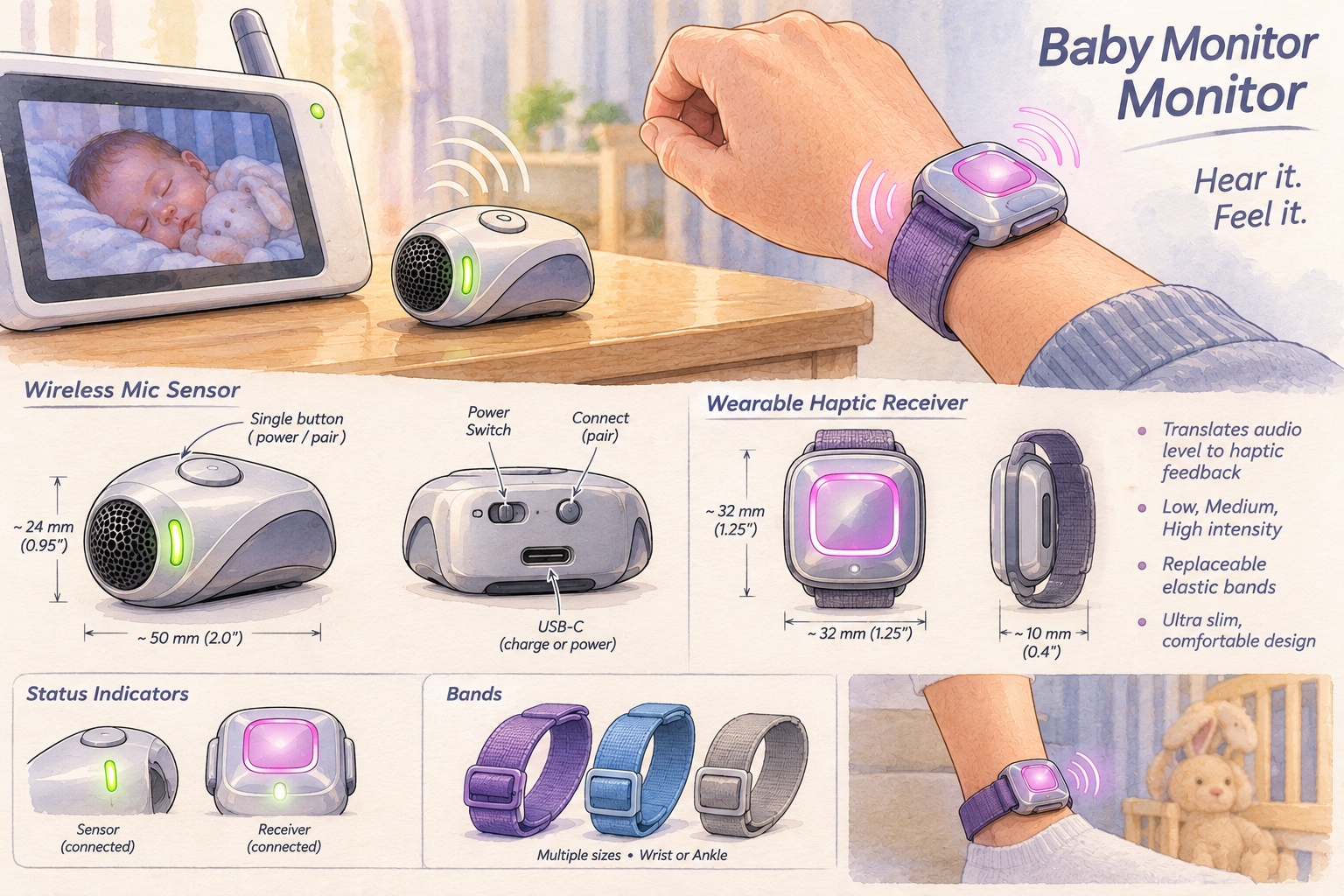
  1. Watercolour concept board of the sensor and the watch
    ConceptThe watercolour concept board
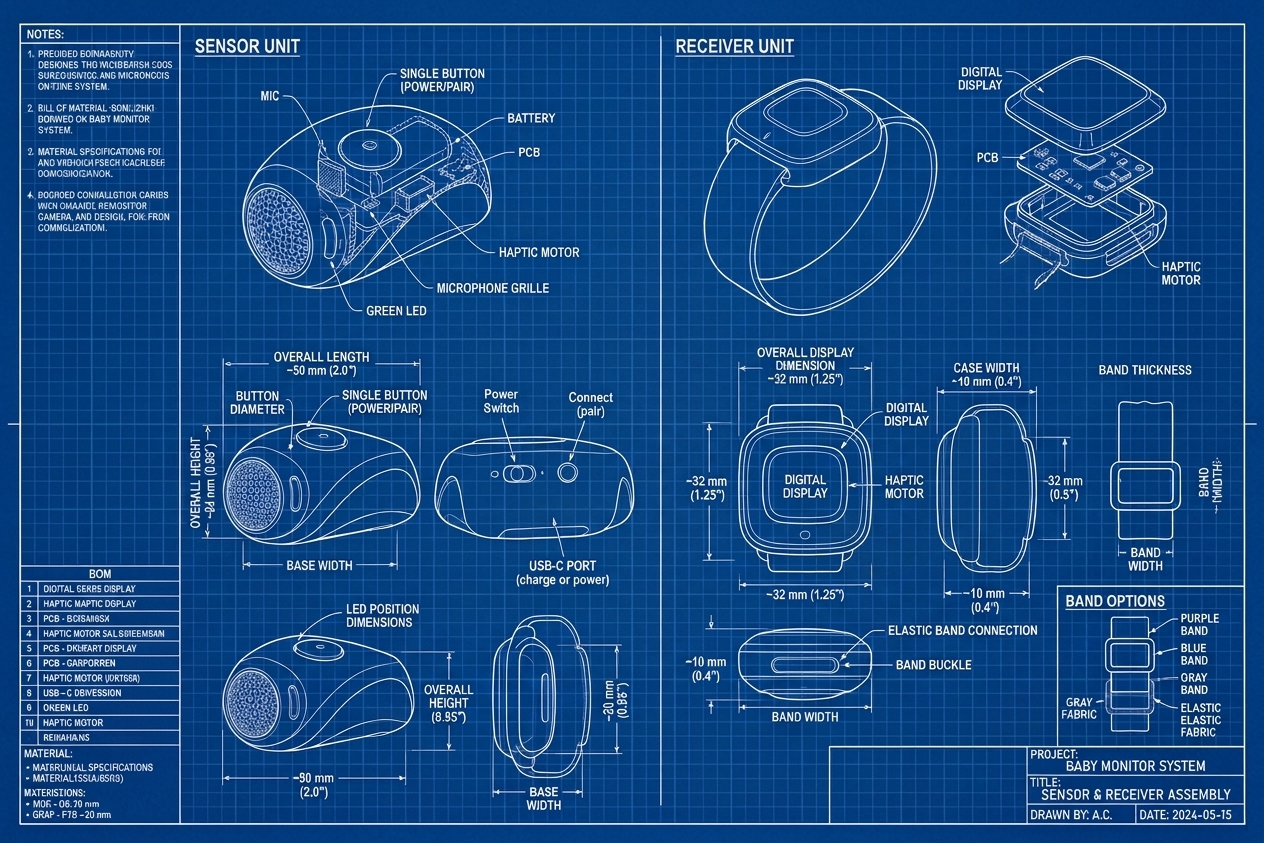
  2. Blueprint layout of the sensor and receiver units
    LayoutThe blueprint drawing
  3. Isometric view of the CAD model of both devices
    3D modelBoth enclosures in Solidcraft
  4. 3D render of the routed watch board
    ElectronicsThe watch board, routed

What we still don't know

This is a speedrun first pass. Here's what we'd answer before anyone orders a board or cuts a mould.

  • Battery

    Does 150 mAh last a whole night?

    The watch has to keep listening for the sensor all night. That only works if the radio sleeps between heartbeats, which is firmware work. Measure it on a dev board before fixing the case thickness. A bigger cell makes the watch thicker.

  • Fit

    The fit check needs a re-run

    Both boards were re-routed (DRC 0 / 0) after the hosts dropped the watch's button and USB port and gave the sensor a bigger cell. The board-in-enclosure fit checks were last run before those changes.

  • Feel

    Will a coin motor wake a deep sleeper?

    An ERM through an elastic band is gentle. If it isn't enough, the upgrade is an LRA with a DRV2605L driver: crisper, stronger and able to play patterns.

  • Hearing

    Can it tell crying from a white-noise machine?

    Loudness alone can't. Lots of nurseries run white noise all night, so the sensor needs calibrating to the room, and probably a filter tuned to the pitch of a cry.

  • Finish

    Chrome that doesn't block the radio

    Real metal plating would shield the 2.4 GHz antennas. The Y2K chrome look has to be NCVM (non-conductive vacuum metallising) or pearl paint.

  • Watch

    How do you stop it from your wrist?

    With no button, you can only stop the buzz from the sensor. A tap gesture would need an accelerometer, and it's still an open question whether the watch should be able to switch itself off.

Build on it

Everything behind Baby Monitor Monitor is open: the 3D design, the KiCad boards and the notes. Download it, change it, make it, even sell it. All we ask is a credit and a link back.

Open the project on GitHubLater revisionsThe build tools

Continue it with an AI agent

Paste this into Claude Code, Codex, Cursor or any agent that can run commands. It fetches just this project and the tools, reads the notes in the right order, and asks you before it changes anything.

Hardware under CERN-OHL-P v2, words and images under CC BY 4.0, code under MIT.

Get each run by email

A short diary of every episode: the roll, the turns the idea took, and the board at the end. One email per episode.